Autumn is in full swing, the leaves on the large tree across the road from my house are bright orange and red, which is in contrast to the yellowy-green leaves on the other trees I can see through my window. Is it just me, or has this year felt like time is a blur, seasons and times rolling into one? Most of us are usually ready to welcome autumn with open arms, we are ready for pumpkin picking, muddy welly walks, crunching leaves underfoot, cooler sunshine, darker evenings, the excitement of a bonfire night evening with friends, swirling sparklers into the crisp fresh air.
However, last winter, was a winter like no other and as this winter is approaching there is an apprehension of what could be lurking around the corner. For those privileged to live day to day free from illness or disability, health can be taken for granted in all sorts of everyday ways. Yet Covid taught and forced the harshest of lessons, disrupting presumptions that wellness is guaranteed and showing nobody is invincible to illness. So, it is necessary that we head into this winter season with intention and make certain we are sufficiently equipped and that we do not leave our wellness to chance.
Did you know around 3% of the UK population, find the changes in the season debilitating and experience seasonal affective disorder (SAD). Due to generational changes in our lifestyles and the combination of poor weather, many of us may not spend enough time outside and in recent years, we are increasingly spending much less time outdoors, working longer hours, with less time for breaks and we live busy fast-paced lives.
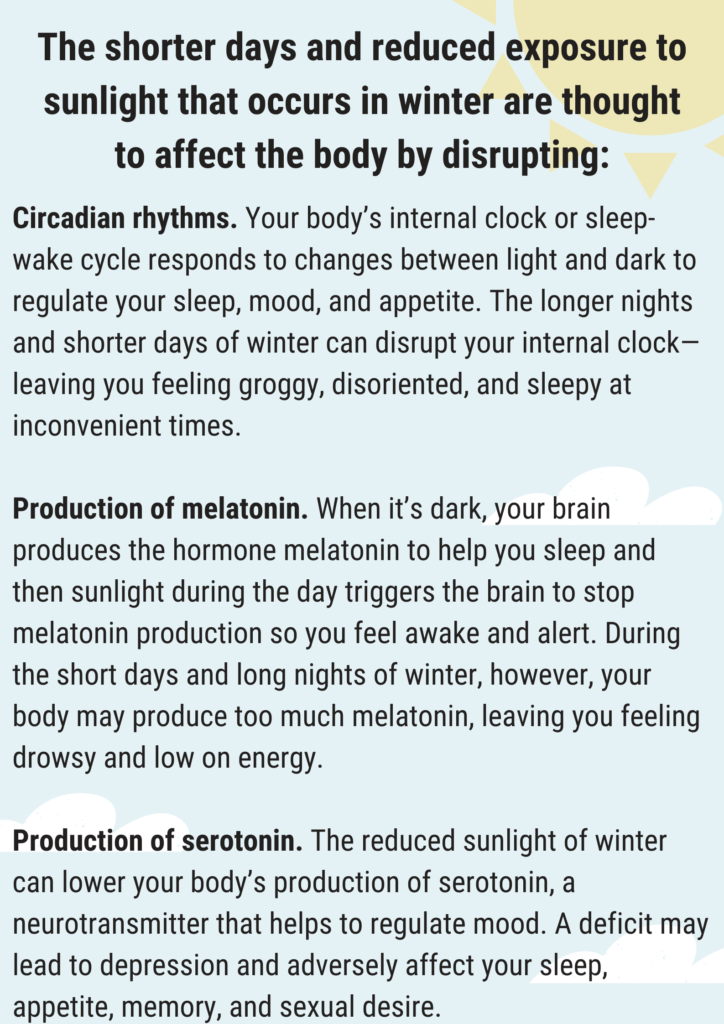
The reduced sunlight in the winter months can cause havoc with our wellbeing and lead to physical and mental health issues. This is thought to be due to a deficiency in vitamin D, which is often referred to as the sunshine vitamin, which is essential in helping keep bones healthy and strong and essential for a healthy immune system and glucose metabolism. Interestingly studies indicate, black people and people of colour are more prone to vitamin D deficiency (O’Connor et al, 2013) this is to do with the melanin in darker skin, which makes it more difficult to absorb the sun and in turn the benefits that the sunshine vitamin brings. The NHS recommends taking vitamin supplements if you have darker skin and are not making enough vitamin D. As winter draws in, the lack of sunshine can also affect our circadian rhythm, production of melatonin and serotonin and it is surprising just how little some of us know about how seasonal changes can affect us. (Robinson & Segal 2021).
Covid, combined with the usual winter germs, cough, colds, bugs and flu has returned with a vengeance, due to us being back in closer contact with others than last winter. This means many workplaces might be short-staffed and dealing with ongoing stress and pressure. We are so comfortable talking about stress, but do we must pay better attention to the damage stress can do.
When our bodies experience stress, our adrenal glands release adrenaline and cortisol, (known as the stress hormone), which can run rampant in our bodies and affect our wellbeing in ways we do not often realise. Basically, our body is trying to keep us safe and has detected a threat, so cortisol and adrenaline are preparing us for the fight, flight or freeze. The stress response also releases glucose, (blood sugar) that controls our energy.
Consider how sometimes we can be starting our days on the back foot without realising it. If say, we are having difficulties with our sleep, or as we are learning, the season’s change and the weather gets colder, days longer and darker, it makes sense our bodies are going to demand more from us, more energy, and crave warmth and comfort, sometimes due to that release of glucose, we demand and reach for the sugary snacks and foods that give us that instant short time fix, and end up in an unhealthy cycle without even knowing.
When we then combine stress, with a vitamin D deficiency and the potential impact of the changes in the weather, we can see how these are all risk factors for our physical and mental health. Being mindful of how we are fuelling, nourishing, and sustaining our bodies is a vital link to our wellness, plus it helps us take care of our gut health. Recent research has indicated 90% of serotonin is produced in the gut, which we consider in the western world as the brain chemical that regulates our mood and is linked to depression.
If we are stuck in a cycle of stress, then so often this means we are frazzled, worn out and depleted, so I add another F to the family of fight, flight or freeze and that is flop! When cortisol is stuck in our systems and affecting our physical and psychological health and affects our behaviour. We need to give ourselves time to rest and replenish.
I am also going to add a fifth F here and that fifth F, should actually be considered as the first F! Dr Bruce Perry, in his recent book What Happened To You? with co-author Oprah Winfrey, tells us about flock. When our threat detection system fires up and our stress response is on high alert, we look around us for safety, we look to others, we look for a safe space, maybe a reassuring face for comfort. What happens in these moments can affect our future health and wellbeing. Without someone to flock to, we do not feel safe. That is why we need a community of care, where not only are we taking steps to safeguard our health, we are looking out for others and empowering them to do the same.
None of us is immune to experiencing ill health and after such an unprecedented time of stress, worry and uncertainty many of us may even be more susceptible to illness this winter. Here are a few ideas to add to your own wellness toolkit to help you tackle this winter:
· Ask for a healthcare check-up with your GP, ask for a blood test if a vitamin deficiency is found, your GP may be able to prescribe vitamins
· Local health shops, often you can have a free consultation to discuss holistic remedies that will promote health and treat ailments and illness
· Did you know you can self-refer on the internet in your local IAPT service (Increased Access to Phycological Therapies) and access Cognitive Behavioural Therapy (CBT)
· Protective factors for mental health include faith, religion and spirituality rediscover family traditions and customs or discover new ones
· Check if you have an Employee Assistance Programme (EAP) at work? It is totally confidential, and you can often a range of really helpful benefits such as CBT, counselling, advice lines, online support and more.
· Make a wellness action plan use the guidance on Mind.org.uk
· Get outside! Spend as much time outside in the daylight as possible, come rain or shine, knowing the enormous benefits it will have for children too
· Make your home and workspaces, light & airy – open curtains and blinds, let the sunlight in
· Sit near windows – organise your office space if you have one or working environment to let the sunlight in
· Find an exercise that feels good for you – and do it outdoors
· Nutrition – eating well, making sure you eat breakfast, lunch & dinner especially meals with vitamin D, such as oily fish, cereals, red meat, egg yolks
· Support – finding a friend or work colleague you can talk to who will listen, and who you can make plans with, and find events and groups in your local community
· Wellbeing at work – highlight the possible impact of the changes in season and how you can make adaptions and take care of one another, such as providing breakfast, healthy snacks, walks together at lunchtime
· Mental Health First Aid England’s My Whole Self Campaign, in 2021 we shouldn’t have to leave parts of our identity behind – be that our cultural or ethnic background, gender identity, sexuality, disability or health – when we work. Wherever you are working from, feeling supported to bring your whole self to work is better for wellbeing and better for business.
References and sources of information:
Nafsiyat nafsiyat.org.uk
Nafsiyat offers short-term intercultural therapy to people from diverse backgrounds
who live in the London Boroughs of Islington, Enfield, Camden, and Haringey. They
provide therapy in over 20 languages.
NHS Every Mind Matters – take the mind plan quiz
https://www.nhs.uk/every-mind-matters/
LGBT Health and Wellbeing
https://www.lgbthealth.org.uk/
Promoting the health, wellbeing and equality of lesbian, gay, bisexual, transgender (LGBT+) adults (16+) in Scotland. We welcome the entire diversity of our LGBT+ community including non-binary, queer, intersex, asexual people and all identities under the LGBTQIA+ umbrella.
Black Minds Matter UK
blackmindsmatteruk.com
Currently, under development, Black Minds Matter is a service that will aim to connect
Black individuals with free professional mental health services across the UK.
Rest for Resistance
restforresistance.com
A US-based trans-led organisation working to empower LGBT+ People of Colour using
meditation. Their website features art and writing by trans and queer People of Colour,
as well as other stigmatised group
MHFA England. Find out more about how you or your organisation can get involved with My Whole Self: https://mhfaengland.org/my-whole-self/
POC Online Classroom
poconlineclassroom.com
US-based resource offering educational and self-care resources for People of Colour.
Sad Girls Club
sadgirlsclub.org
An online platform and community to bring together young Women of Colour with
mental health issues.
Wellness Action Plan
Seasonal Affective Disorder
https://www.nhs.uk/conditions/seasonal-affective-disorder-sad/treatment/
Melanie Cura Daball and Peter Kimpton, 2015.
https://www.theguardian.com/uk-news/2015/oct/23/how-do-i-deal-with-seasonal-affective-disorder
Lawrence Robinson and Jeanne Segal, Ph.D. https://www.helpguide.org/articles/depression/seasonal-affective-disorder-sad.htm
O’Connor et al. Proc. Cardiovasc. Dis. 56(3) p261 (2013)